
Appearing as a Source in Google AI Overviews
LE VENT GLOBAL MEDIA · SEO
Appearing as a Source in Google AI Overviews
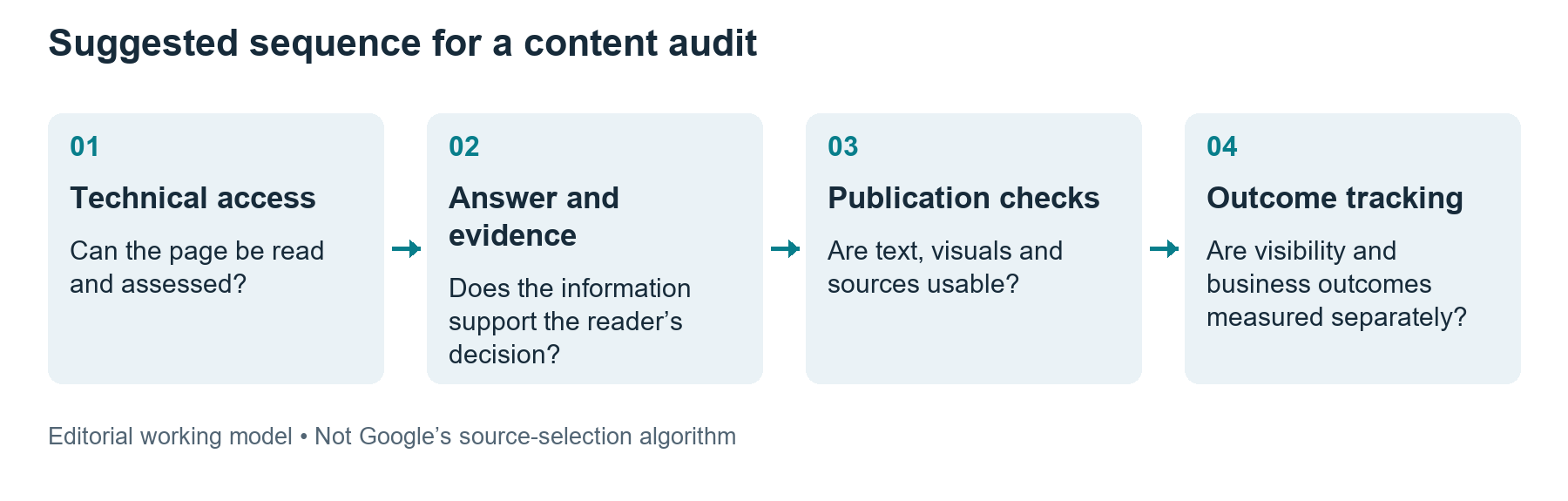
When preparing to appear as a source in Google AI Overviews, start by choosing an important customer question and auditing your answer. Is your page accessible, does it substantiate its claims, and does it offer information that readers cannot easily find elsewhere? This guide turns those questions into a practical content audit.

AI Overviews are AI-generated summaries that Google displays in some search results. They can bring together information from several sources and link to relevant pages. For a page to be eligible for one of these links, it must be indexed by Google and eligible to appear in search results with a snippet, the descriptive text accompanying a result. Meeting these conditions does not guarantee inclusion. [1]
This article is for business owners, marketing managers and content teams. By the end, you will be able to decide why to improve a page, what evidence to add and how to assess the change. The proposed audit and work schedule are not an official Google scoring system.
What changed in 2026
On 15 May 2026, Google published new guidance on visibility in generative AI features. One of its central themes is original content that goes beyond generic information anyone can repeat. A more meaningful objective, therefore, is to produce an account of experience, research or a practical example that explains a real problem, rather than refreshing an article simply by adding keywords. [2]
For example, in an article about why an e-commerce website is slow, you could show which file delays loading on which product template instead of repeating the importance of image compression. Explain the test conditions, the previous state and the measurements after the fix. Readers can then understand the problem and assess whether your recommendation applies to their own site. If you use customer data, obtain permission to share it and anonymise it where necessary.
What research tells us about clicks
In research published by Pew Research Center in July 2025, users clicked a traditional result in 8% of visits to Google results pages containing an AI summary, compared with 15% of visits without one. A click on a source link within the summary was observed in 1% of visits that included a summary. [3]
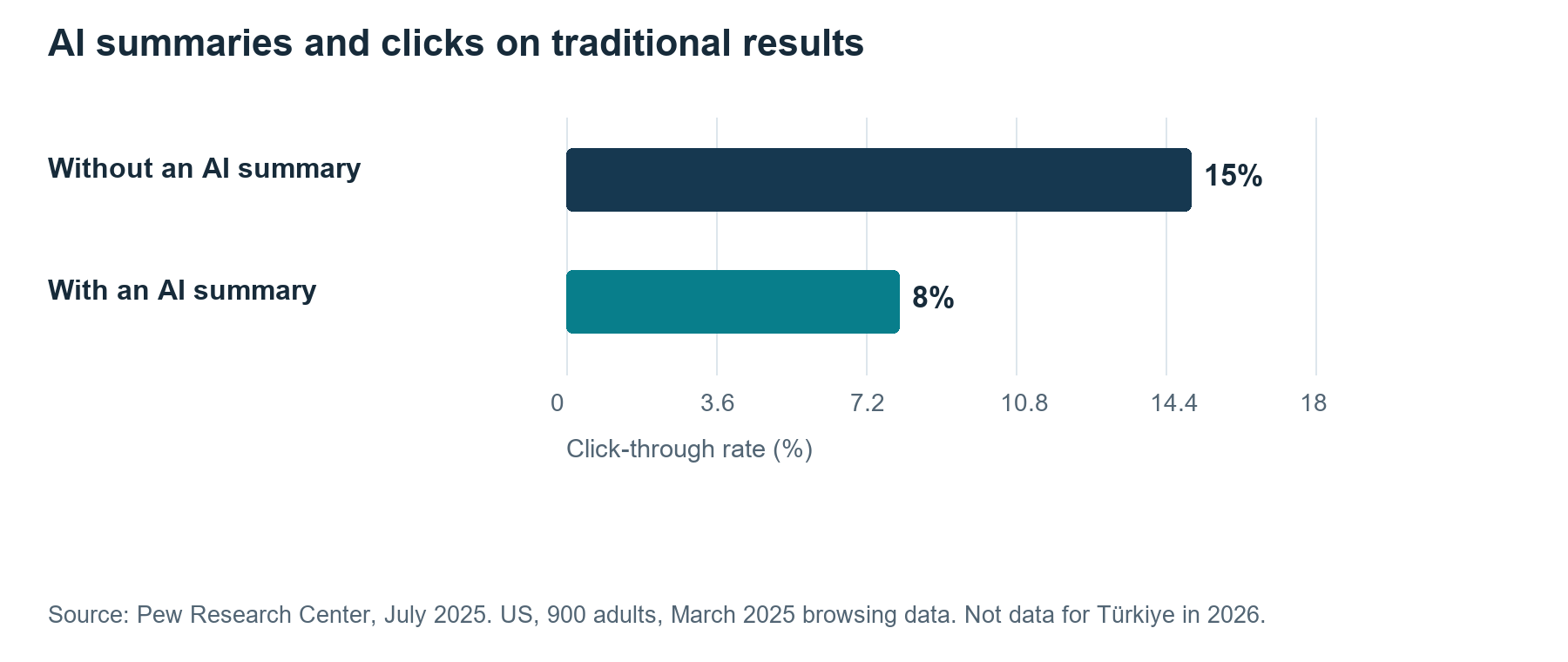
The study covered 68,879 unique Google searches. Researchers collected the results for the March queries again between 7 and 17 April 2025, so the possibility that results changed over time is a methodological limitation. These figures should not be used as a formula for calculating losses on your own website. [3]
An Ahrefs study dated 4 February 2026 compared desktop Search Console data for 150,000 informational keywords with AI Overviews and 150,000 without them. Using December 2023 and December 2025 data, it estimated the click-through rate of the first-ranking page relative to the control group. The observed rate in the AI Overview group was approximately 58% below that estimate. [4]
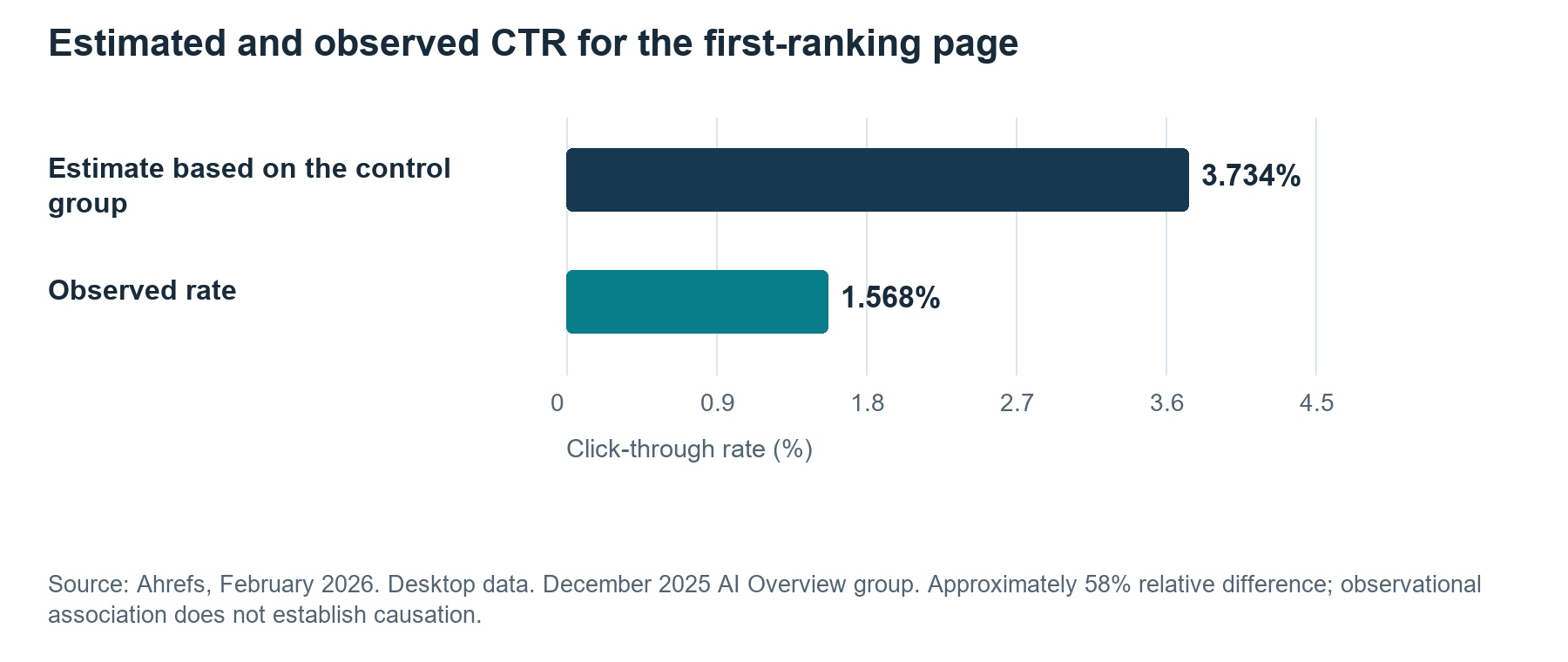
The two studies measure different things. Pew examines users’ next actions, while Ahrefs examines aggregate click-through rates for keyword groups. Do not combine their results into a single average. For your business, the implication is to track source visibility alongside qualified visits to your website. Being cited as a source does not automatically generate traffic or sales.
Which page should you audit first
Rather than updating the entire blog at once, choose one page close to a customer decision. A question that your sales team frequently receives, that prolongs the quotation process when misunderstood, or that makes choosing a product difficult is a good starting point. Instead of a broad subject such as “What is enterprise SEO”, choose a specific decision problem, such as “How should country pages for the same product be separated on a multilingual e-commerce site”.
When selecting a page, consider its current impressions, its relevance to your business and the original evidence you can provide together. A high-impression article with little connection to your service need not take priority over a narrower article that solves the right customer’s technical problem. If you have no original example, allow time for research or practical work; do not write as though you have experience you do not possess.
In your baseline record, include the target page’s URL, the question it addresses, the relevant service and the reason for updating it. As a suggested initial review period, you could record the last 28 days of data. This is not a Google requirement; low traffic or seasonality may call for a longer period.
Check technical eligibility first
There are no additional technical eligibility requirements for Google’s AI features. Fundamental checks, including discoverability through internal links, presenting important content as text and allowing Googlebot access, still apply. [1] If you work with a developer, ask for evidence alongside the question “Is the page accessible”: URL Inspection output, the returned status code and the main content Google sees.
Check | Evidence to examine | Action if an issue is found |
|---|---|---|
Access | HTTP response and firewall logs | Resolve the cause of the error or bot block |
Indexing | Search Console URL Inspection | Review indexing status and the selected canonical URL |
Preview permissions | Robots meta tag and response headers | Correct unintended noindex or nosnippet rules |
Main content | The page Google fetches or renders | Confirm that the answer and evidence are accessible as text |
Internal links | Relevant category and guide pages | Add a meaningful navigation route for readers |
Blocking crawling with robots.txt and removing a page from the index are different actions. A URL that Google cannot crawl may still appear in results without its content being read if other pages link to it. Opening access in robots.txt alone therefore does not prove that an indexing problem has been resolved. [5] Recheck URL Inspection after making changes, and record that crawling and indexing are separate stages.
Assess preview settings separately as well. Nosnippet, max-snippet and data-nosnippet provide different controls over text that can appear in search results. [6] A sitewide setting may also affect the main answer you want to make visible. Do not try to resolve this by exposing private or contractually restricted content; choose permissions appropriate to the page’s publishing purpose.
Test whether the answer actually helps the reader
Can someone who reads the opening section understand what to do? If the answer is lost among promotional sentences, first state the main recommendation and the conditions under which it applies. Then provide the reasoning, implementation steps and exceptions. Retain the context readers need to make a decision, rather than turning every paragraph into a separate short answer.
Include details that change the reader’s decision
Explaining when a solution is unsuitable is as important as explaining when it works. If you recommend merging category pages, for example, distinguish similar product inventories from different search intents. Do not decide to merge two pages merely because their titles look alike. Show an example that considers the relevant queries, product coverage and customer expectations.
Make your original contribution visible
Your original contribution might be a test, a field observation, a decision table or your own working method. Explain the method so readers can assess that contribution. They need to know which device was used for a speed measurement, which pages were selected for a content review, or who responded to a customer study, when and how. Do not draw conclusions about an entire sector from one example.
Google’s helpful content guidance also emphasises making it clear who created content and how it was produced. [7] Add the person actually responsible to the author field; if a technical review took place, state the reviewer’s role. A name or job title does not substantiate an undocumented claim. The basis for the claim must be in a test, dataset or source the reader can inspect.
Turn a generic paragraph into an actionable answer
The example below is not a case study showing that a page appeared in AI Overviews. It illustrates an editorial improvement. Suppose the subject is an e-commerce website whose filtered category pages generate similar URLs.
Wording that needs improvement: “Filtered pages should be optimised for SEO. Canonical tags should be used correctly and unnecessary pages should be blocked.” This tells readers neither which page to retain, which data to examine nor which risk to manage.
More useful wording: “First review the URLs generated by colour and size filters in separate groups. Distinguish filter pages that offer users a meaningful choice and are supported by available stock from URLs that merely change the order of the same list. For each group, record search demand, product coverage and the current indexing status. Make the technical decision after this grouping.”
Even the second version is not a complete technical solution by itself. It should be followed by an anonymised URL pattern, the reasoning behind the decision and a post-implementation check. For example, a visual explaining why a sorting parameter is not managed as a separate landing page is more useful than an abstract reference to “optimisation”. The aim is to let readers follow the decision process.
Make sources and statistics verifiable
Whenever you include a figure, record the source name, publication date, data collection period, sample and metric together. A standalone sentence such as “AI reduced clicks by 58%” hides which position, device or comparison is meant. Even when a study uses strong language, make the limitations of its observational design clear to readers.
Open the primary source and check what the figure means. Do not confuse percentages with percentage points. For example, the difference between 15% and 8% is 7 percentage points. When applying a rate to another period, country or search type, do not assume the same conditions hold. This is why the scope of the data belongs beneath the chart.
Citing a source does not replace your own analysis. [7] Connect the research to the reader’s decision: if clicking behaviour is changing, investigate which pages offer visitors additional value and whether those visits lead to objectives such as enquiries, trials or purchases. Redrawing someone else’s chart does not produce original experimental data; identify the data source clearly.
Check the WordPress page before publishing
When transferring content to WordPress, do not assess it solely in the editor. Open a preview at mobile width. Check that decision tables are readable, the text in images is understandable without zooming and source links lead to the correct pages. Explain the principal finding from each visual in the text too, so the information is not confined to an image.
Use the article title in the H1 field generated by your theme; main sections in the article body should use H2 and subsections H3. Choose a short, descriptive URL. Write the description in your SEO plugin to reflect the content readers will see. Because Google can also create snippets from page content, do not expect your chosen meta description to appear unchanged in every search. [6]
If you use structured data, ensure it is consistent with the visible page content. Do not mark up reviews or an author that do not actually exist, for example. Google’s structured data rules prohibit marking up invisible or misleading content. [8] Also check the markup generated when a plugin is installed; a setting being enabled does not establish that the data is correct.
Filter out claims that waste time
According to Google’s 2026 guidance, no special schema type or llms.txt file is required to appear in AI search. Dividing content into small chunks or reaching a particular word count is not mandatory either. [2] Use tables when a comparison is needed, short answers when a quick explanation is appropriate and longer explanations when the subject requires them.
Look for measurable evidence behind recommendations such as “guaranteed citation within thirty days”, “mandatory paragraph length for AI” or “visibility through hidden markup”. A screenshot that does not identify the tested query, country, device and date cannot substantiate a broad success claim. In a service proposal, describe the work to be done separately from the outcome to be measured. Improving a page can be promised; Google choosing that page cannot.
Monitor changes at three separate levels
First assess whether technical eligibility has been maintained, then search visibility and finally the business outcome. This distinction helps you identify the issue when your source is visible but clicks do not increase, or when traffic rises but enquiry numbers remain unchanged.
In June 2026, Google announced separate Search Console reports for generative AI visibility. The late-August update to the announcement states that the global rollout had been completed. The reported fields are impressions, pages, countries, dates and, for Search, a device breakdown. [9] Do not infer direct sales or conversions attributable exclusively to AI Overviews from a visibility report.
Level | Indicator to monitor | Question answered |
|---|---|---|
Technical eligibility | Indexing status and preview permissions | Is the page eligible for consideration in Search |
AI visibility | URL impressions in the relevant report | Has the page appeared in AI features |
Organic traffic | Landing-page visits and clicks | Are people visiting the website |
Business outcome | Qualified form submission, trial or sale | Do visits contribute to the objective |
You can also maintain a fixed query list for review. At each observation, record the query, language, country, device, date and the URLs shown as sources. “The brand was mentioned” and “Our URL was linked” are separate findings. This small sample does not represent your visibility across all queries; it is a supporting record to help the content team decide what to investigate.
Monitoring similar pages that you have not changed alongside the updated page can help reveal broader movements in demand. Nevertheless, rankings, advertising, seasonality and other website changes may affect the result. A before-and-after comparison does not prove that an observed increase was caused solely by the content revision.
A practical work plan for the first month
The schedule below suggests an order of work for a small team. One month is not a promised timeframe for appearing as a source or for Google to process a change. If technical problems are substantial, assess the content refresh after resolving the access issue.
Period | Work | Evidence of completion |
|---|---|---|
Week 1 | Select the page and customer question; collect baseline data | URL record, sample queries and technical findings |
Week 2 | Produce missing evidence; improve the answer and examples | A test or practical example with its method explained |
Week 3 | Complete technical and editorial checks, then publish | Mobile preview, link checks and change log |
Week 4 | Review initial observations; plan the next check | A record assessing visibility, traffic and business outcomes separately |
During the final pre-publication read, return to this question: “Would this page help our target customer even if it never received a visitor from Google?” If the answer is unclear, strengthen the example, explanation or decision support before adding another keyword section. A useful audit should deliver a more helpful page, not merely completed checkboxes.
Frequently asked questions
Do you need to pay to become a source in AI Overviews
This guide concerns organic supporting links. Paying an agency for its work does not guarantee that Google will select your URL as a source. Assess advertising placement and organic source visibility separately in a service proposal.
Does an article need to be very long to appear
Google’s guidance does not specify an ideal page length. [2] Explain the subject sufficiently for readers to make a decision. Remove repetition; do not delete a method, exception or necessary implementation step simply to shorten the article.
Why might appearing as a source generate no visits
A user may be satisfied with the summary or continue to another source. Keep visibility records separate from traffic and conversion records for this reason. A link having appeared does not establish that anyone clicked it.
Can content prepared with AI assistance be published
When assessing the production method, check accuracy, original contribution and actual editorial accountability. Google’s guidance recommends explaining how content was produced where readers would reasonably expect that information. [7] Do not present a test that was never performed or a product that was never used as first-hand experience.
How long should we wait after an update
There is no universal timeframe. Google states that recrawling can take anywhere from days to months, depending on crawl frequency. [1] Record the publication date and technical changes; do not interpret a few days of fluctuation as success or failure.
References
Sources accessed on 27 October 2026. Research data periods may differ from publication dates; these are specified separately in the relevant charts and text.
[1] Google Search Central. AI features and your website. Technical eligibility, fundamental SEO checks and recrawling conditions.
[2] Google Search Central. Optimizing your website for generative AI features on Google Search. Guidance announced on 15 May 2026. Original content and assessment of claims about special optimisation.
[3] Pew Research Center. Google users are less likely to click on links when an AI summary appears in the results. Athena Chapekis and Anna Lieb, 22 July 2025. 900 US adults; March 2025 browsing data, results pages collected in April 2025.
[4] Ahrefs. Update AI Overviews Reduce Clicks by 58 Percent. Ryan Law, 4 February 2026. 300,000 keywords; desktop data; comparison of December 2023 and December 2025.
[5] Google Search Central. Introduction to robots txt. Differences between crawling rules and indexing.
[6] Google Search Central. Control your snippets in search results. Preview controls and limitations of meta descriptions.
[7] Google Search Central. Creating helpful reliable people first content. Authorship, production methods, original effort and reader benefit.
[8] Google Search Central. General structured data guidelines. Consistency with visible content and misleading markup.
[9] Google Search Central Blog. Introducing Search Generative AI performance reports in Search Console. Announcement of 3 June 2026 and global rollout note of 31 August 2026. Scope of impression reports.


